🐾 Cumulative total 42,357 people
MBTI x Attachment Style to Understand Your 64 Types
Total 46 questions, approximately 5 minutes. We will find your personality and mental quirks that appear in love for free.
📖 View the 64 type encyclopediaAll 64 characters with appearance rate
How This Quiz Brings Different Perspectives Together
Understanding relationships means looking at personality and responses in close relationships together.
A personality quiz can offer clues about everyday tendencies. Difficulties in romance may also involve responses to people close to you. This site looks at these perspectives separately and then interprets them together. Combining two theories does not make relationships precisely predictable.
For Example: No Reply for Three Days
- From a Personality Perspective You might describe yourself as cautious or prone to overthinking, but that alone doesn't explain every response.
- From an Attachment Perspective You might notice anxiety, while still needing to consider the situation, expectations and relationship history.
- Considering Both Perspectives When looking for meaning combines with fear of rejection, you might build three days' worth of stories in your head before reaching out. This is an interpretation to compare with your experience, not a prediction that must come true.
| What We Explore | Conceptual Background | Prompts for Reflection |
|---|---|---|
| The 16 MBTI Types | Four Preference Pairs Developed Against the Background of Jung's Typology (1921) | How You Take in Information and Make Decisions Whether You Focus on the Facts of Being Left on Read or Start Looking for Meaning |
| Four Attachment Patterns | Bowlby's Attachment Theory (1969) and the Adult Attachment Dimensions of Anxiety and Avoidance | How Easily Your Inner Alarm Activates in Close Relationships Whether a Missing Reply Triggers Worry |
| Receiving Care · Caregiving | Takeo Doi's work on amae (1971) and the caregiving system in attachment theory inform the design; they do not establish this quiz's validity. | Whether You Want to Lean on Someone or Care for Them Seeking Support When You Struggle, or Offering It When Someone Else Does |
This site's relationship index combines attachment anxiety, attachment avoidance, wanting care, wanting to give care and agency, with personality-related adjustments at a smaller weight. These weights are design choices made by this site, not established predictions of relationship success. In particular, sociability and openness are not graded as relationship strengths. Use the index to organize your answers and begin reflection, not as a ranking of romantic ability, a national percentile or a guarantee about future relationships.
Psychometric evaluations of MBTI are mixed. This site uses types as prompts for self-description and to explore possible response patterns alongside attachment tendencies, not to predict an individual precisely. Attachment tendencies need not be treated as an inborn, fixed identity; relationship experiences may be associated with change.
Big Five character quiz
YOUR NEXT STEP
In that connection, What is happening now?
After knowing the type, the question that remains is, "So, what will happen to this relationship?" Quizzes are divided by location.
All are free and no registration is required. Work character quizzes (Chiikawa, One Piece, Demon Slayer: Kimetsu no Yaiba, Naruto, etc.) are available in the quiz list.
See the full list of quizzes →How is this quiz made?
This site is not an official MBTI® test, but an original quiz that combines attachment theory. We disclose the basis and information sources for our judgments.
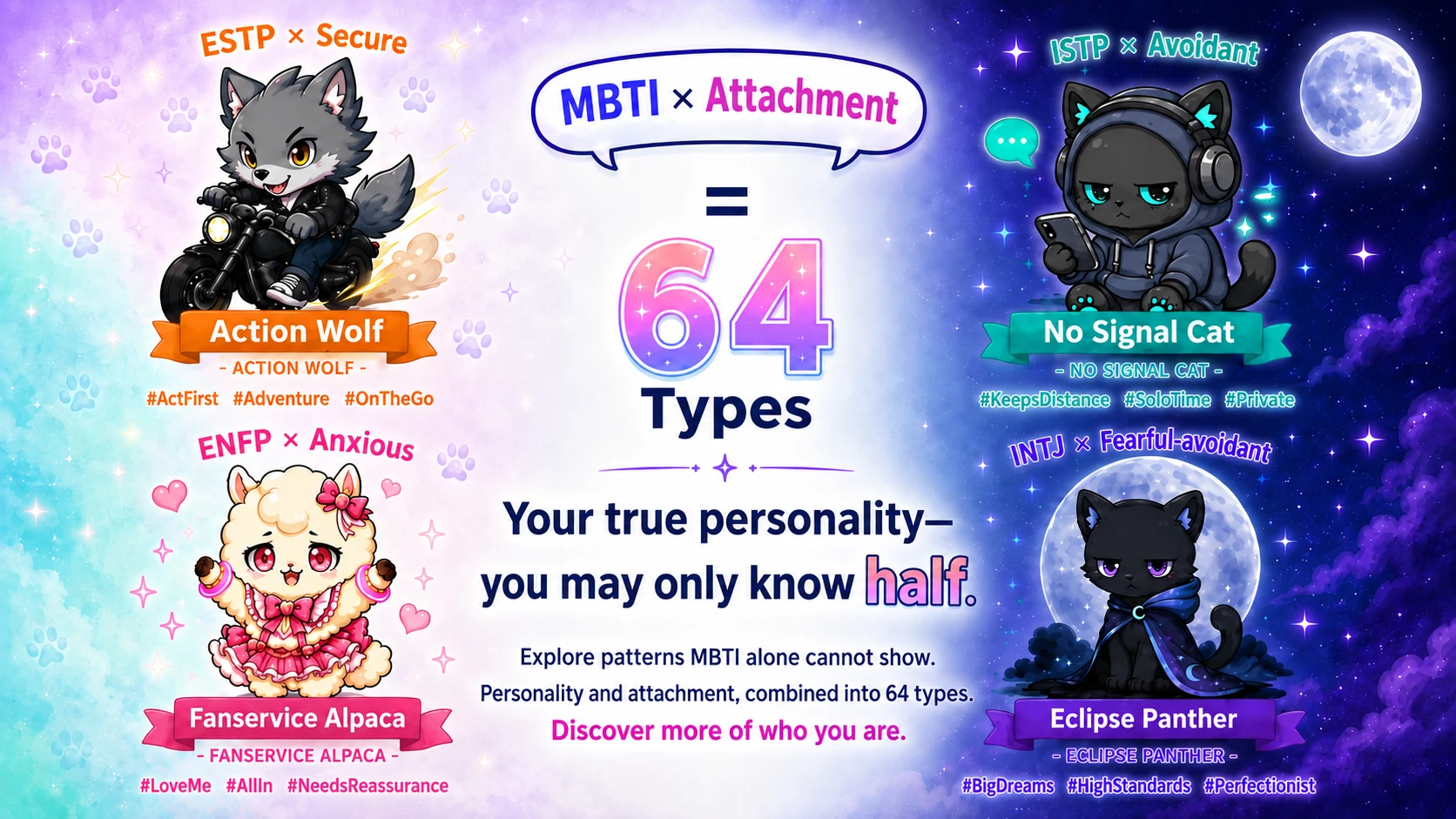
We combine 16 MBTI-style personality types (ways of thinking) with four attachment styles (ways of relating to people close to you) to form 64 types. The four attachment categories follow the Bartholomew & Horowitz (1991) model, which distinguishes views of self and others.
The rarity ranking and distribution by type are not numbers borrowed from outside. Anonymous aggregation of responses from this site. It will be automatically updated each time the number of people increases. It is not linked to personally identifiable information.
Character and public-figure type assignments are editorial interpretations and estimates. We distinguish biographical and fictional source material from the reasoning behind a type interpretation, and publish entries with individual sources and verification records. Unsupported interpretations are not presented as established facts about someone's personality or health.
The results are a description of a trend, not a medical diagnosis. Attachment styles change with relationship experience, so they should not be treated as fixed names. If we receive a valid point, we will review it and revise the description.
Management/Editor in charge: Reiya Ogane
Responsible for scoring logic, anonymous aggregation, and pre-publication confirmation of articles. Judgment criteria, references, and generation AI usage policy How the quizzes work and our editorial policy .
🔀 Frequent MBTI by attachment type
Explore attachment style and MBTI across 42,256 quiz records from all language editions. This sample does not represent the general population.
🌀 Most common among fearful-avoidant types
INFJ
21.5%
n=17,150
🛡️ Most common among secure types
INFP
13.3%
n=12,739
🔒 Most common among avoidant types
ISTP
13.6%
n=5,799
💓 Most common among anxious types
INFP
19.3%
n=6,568
🔒 Top 3 MBTI among avoidant types
n=5,799
💓 Top 3 MBTI among anxious types
n=6,568
The avoidant types are classified into the T type (thinking type), and the anxious types are classified into the F type (feeling type). The difference is that when cornered, one protects himself by "cutting" and the other by "holding on."
📊 Data article
MBTI by attachment style (42,256 pooled quiz records) →
Overall picture of 16 types x 4 attachments, the ranking of 64 types, and even the bias of the person taking it. Automatically updated as more answers are added.
📝 Data analysis column
Why are only N-types (intuitive types) worried about attachment →
N-type results: 53.1% in this site's quiz records. This sample does not represent the general population.
Two psychological theories will explain you
Jungian psychology, which has a history of over 100 years,
Bowlby's attachment theory is the gold standard in developmental psychology.
By integrating these two, we have realized deep analysis that was not possible with conventional MBTI.
What are the four attachment styles?
Based on research on adult attachment, interpersonal relationships are organized into four categories.
It varies from person to person, and may change depending on the person you are talking to or the situation.
Secure Secure
The most balanced type, able to trust both themselves and others.
- You can give your partner a sense of security without being overly anxious about love.
- I can honestly express my feelings
- Build deep bonds while respecting the freedom of others
- Even if you fight, you can resolve it through constructive discussion.
Avoidant Avoidant
A strong independence-oriented type who unconsciously puts a brake on intimacy.
- It is easy to feel that it is easier to be alone, and it is difficult to express emotions.
- When the other person gets too close, I want to keep my distance.
- Strong resistance to showing one's weaknesses
- I tend to prioritize work and hobbies over love.
Anxious Anxious
Because of his strong desire for love, he is the type of person who is always happy or sad about the other person's reaction.
- I get worried about trivial things like "I might be disliked."
- I'm overwhelmed by the slow reply.
- Sometimes I give too much to others and lose sight of myself.
- Has a strong need for approval and always wants to feel loved.
Fearful-avoidant Fearful
The desire for intimacy and the desire to maintain distance tend to overlap.
- I want to be intimate, but when I get close, I want to run away.
- Unconsciously putting up a line of defense thinking "I will be betrayed anyway"
- My emotions are so intense that it is difficult for me to control them.
- Past experience is also a background. I don't know the cause just the type
Why are you attracted to people who don't suit you?
Anxious types and avoidant types are attracted to each other like magnets.
In psychology, this is"The attachment dance".
"I want to get closer"
"Don't come close"
Meeting: Sometimes There Is Strong Chemistry
Some people feel drawn to someone who expresses closeness differently, but anxious and avoidant tendencies do not inevitably attract each other. Strong chemistry cannot be explained by attachment style or childhood alone.
Chase and escape loop
When one person seeks closeness and the other wants space, withdrawal can increase worry and lead to more pursuit. This cycle is sometimes described as an attachment dance, but it does not occur in every relationship or depend on attachment alone.
Getting Used to a Calmer Relationship
A calm relationship may sometimes feel less exciting. Romantic excitement can include affection alongside anticipation and anxiety. A racing heart alone cannot tell you whether a relationship is loving or unhealthy. Consider whether you feel safe, respected and able to communicate openly.
Are you currently dancing the "dance of attachment"?
Knowing your attachment style is the first step to changing your love patterns.
🐾 Find your attachment style🌟 What type is that person? Character/Celebrity Dictionary
Across anime, K-pop and public figures, a total of 1,682 profiles. From your favorite MBTI x attachment type to celebrities who have the same type as you.
See all
📚 Open character/celebrity dictionary 🎬 Search by work/group
AFTER YOUR DIAGNOSIS
What you can do next after the quiz
If the previous results remain on this device, you can continue reading from where you left off without having to answer 46 questions again.
📂 Results saved on this device
Results can only be saved within this terminal. Your name and answer details will not be sent here.
Which 64 type are you?
A total of 46 questions, about 5 minutes, reveals the deeper layers of your personality and love patterns.